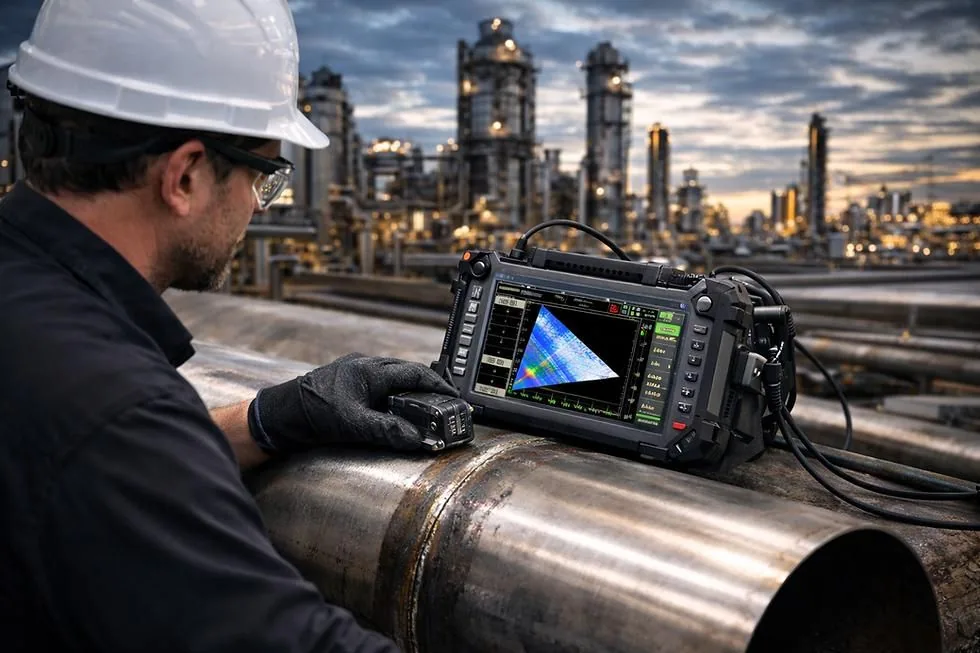
How Electronic Beam Steering Works
Conventional ultrasonic probes rely on a single piezoelectric crystal bonded to a fixed-angle wedge—meaning an inspector manually sweeps back and forth while mentally picturing a single sound angle. Phased Array Ultrasonic Testing (PAUT) replaces that single crystal with an array of 16 to 64+ miniature elements pulsed sequentially with sub-microsecond time delays ("focal laws").
By adjusting firing delays electronically, one PAUT probe steers, focuses, and sweeps ultrasonic beams across a complete fan of angles (for example, 40 degrees to 70 degrees shear waves) simultaneously from a compact scan footprint.
Practical Operational Advantages
- Sectored Cross-Sectional Imaging (S-Scan): Real-time color-coded weld cross-sections show bevel geometry, root penetration, and side-wall lack of fusion in intuitive visual format.
- No Radiation Exclusion Zones: PAUT inspects live plant tie-in welds concurrently alongside fitters, scaffolders, and coaters.
- Superior Planar Defect Detection: Unlike radiography—which struggles when tight lack-of-fusion lies aligned with the weld bevel rather than the X-ray beam—multi-angle PAUT hits bevel walls near perpendicularly.
Essential Limitations & Prerequisites
PAUT is not plug-and-play. Accurate results depend on strict procedural discipline:
- Validated Scan Plans: Every pipe diameter and weld bevel requires focal-law verification proving full weld-volume and heat-affected-zone coverage.
- Surface & Crown Condition: Loose weld spatter, undercut grooves, or narrow scan shoulders prevent smooth encoder travel and skew positional registration.
- Coarse-Grained Alloys: Austenitic stainless steel and dissimilar nickel-alloy welds scatter shear waves; these require specialized longitudinal dual-matrix array configurations and qualified mockups.
Required Deliverables
Always specify that your PAUT vendor supplies both the formatted inspection report and the archived raw digital inspection files calibrated against traceable reference blocks.